One of the greatest sights in Singapore are two shell shaped conservatories. One is for flowers and the other for plants The one shown is for flowers, although the plants one is more exciting, there is no room for another photo here. But you can see part of the giant scale of this building, and not only are there no pillars at all, but it is entirely air conditioned. Even Singaporeans are surprised that a building of the magnitude with clear glass panels can be successfully air conditioned in hot Singapore.
The tree shaped metal objects are about 45' tall - large. The are encrusted with orchids and other plants and vines. There nine of them (I think, could be 12) and several are actually solar cells providing power to the multicoloured lights that make them a spectacular sight at night.
Right close to this large park is what Singapore calls a battery. That is actually a reservoir to collect run off water from the city-state and clean it for all uses. Since Singapore and Malaysia parted ways decades ago, Singapore has had to play nice-nice with Malaysia because it depended on them for fresh water. But over the past 20 years, Singapore has built so many batteries that it soon will be self-sufficient for fresh water even though it has grown so much.
You have to admire Singapore. Iran has all that oil, but no refinery and has to depend on foreign countries to refine its oil. Little Singapore has no oil, but one of the world's largest refineries. They never lack for resourcefulness nor daring.
In the background, you can see ships in the harbour. You can see more ships at anchor here than almost anywhere else in the world. They go on for miles. They stop at Singapore for fuel, insurance, crew changes, and supplies.
Thursday, January 30, 2014
Vietnam and Singapore, January 2014
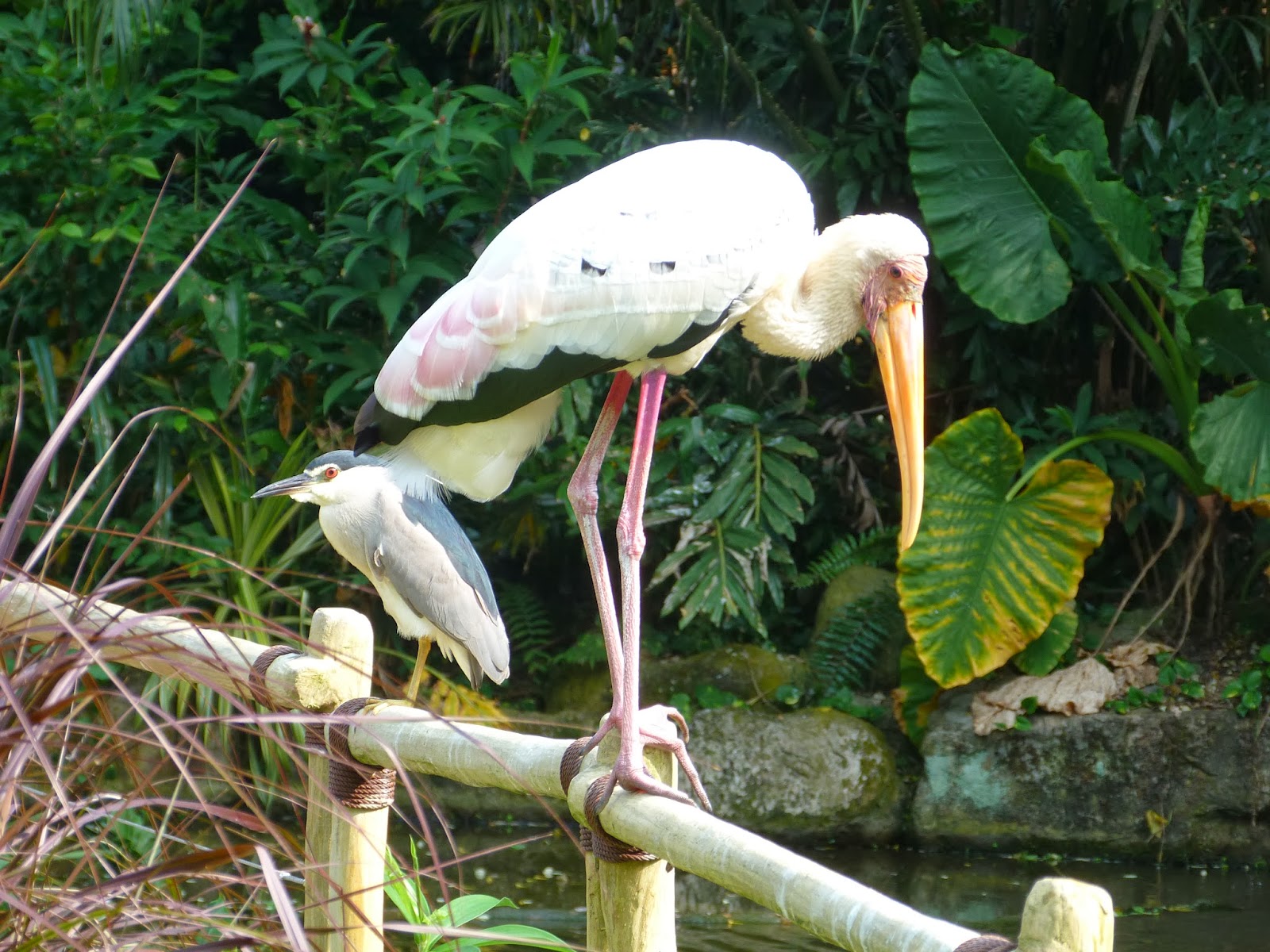
One of the reasons I wanted to get back to Singapore was that I had never visited Jurong Bird Park. It is a huge and beautiful park with thousand of birds, the great majority of which are free and in the open. There are beautiful king penguins inside a chilled glass and rock enclosure. There are some species in large cages. One group of S.E. Asian birds is in about a two block square enclosure of genuine heavy jungle around a man made 100' waterfall. It has nets over it, but from 25' to 105' over the trees and is kind of hard to even notice most of the time (if you are not a bird of course). There are many feeding shows. The one in the netted enclosure allows visitors to hand feed birds - which is thrilling.
The Shoebill shown at the top here, but it was more than 4' tall and quite friendly. I hope you are able to enlarge the nine birds hopping up the stone stairs - they are wonderfully spotted and charming
This visit to the bird park was one of the highlights of my trip and I am so glad I was there. Among other things, I really wanted to see some nesting storks up close and had contemplated a trip to Poland just for that purpose. But I saw lots of them up close and nesting and they were wonderful.
Hoi An, Vietnam
You may recall that Hue and Danang were both near the DMZ and (sickeningly) in the news constantly for years. Hue is a historically interesting city today and although there are many references to the war, it is long behind most of the people. Danang is nearby and is quite a vibrant city. It has a busy downtown, and three quite tall glass-wall buildings. (maybe 30-32 stories). Although the city is hideous, the beach area is developing with many big hotels and one convention hotel.
The important thing about Danang is that it leads to Hoi An 25 miles away - if your taxi driver can find it - which mine could not and a 20 minute normal ride took more than 2 hours.
Hoi an is an ancient town with a population of 120,000 today. It is midway between Hanoi and Saigon and is on the coast, and was little affected by the wars. It has a nice beach. But as it was raining quite heavily most of the days I was there, I did not attend the beach.
I stayed in the Hoi An Historic Hotel. The Historic part of the title only means it is in the old part of town. The hotel is a modern four star, although it does sport several beautiful old oaks.
The traditional Viet house is handsome and it is difficult to grasp how they became so fond of ugly. The old part of town has many nice buildings, a good market and many interesting shops. Interesting shops means they do not all have the same repetitive junk and do not sell mainly t-shirts and mugs.
The important thing about Danang is that it leads to Hoi An 25 miles away - if your taxi driver can find it - which mine could not and a 20 minute normal ride took more than 2 hours.
Hoi an is an ancient town with a population of 120,000 today. It is midway between Hanoi and Saigon and is on the coast, and was little affected by the wars. It has a nice beach. But as it was raining quite heavily most of the days I was there, I did not attend the beach.
I stayed in the Hoi An Historic Hotel. The Historic part of the title only means it is in the old part of town. The hotel is a modern four star, although it does sport several beautiful old oaks.
The traditional Viet house is handsome and it is difficult to grasp how they became so fond of ugly. The old part of town has many nice buildings, a good market and many interesting shops. Interesting shops means they do not all have the same repetitive junk and do not sell mainly t-shirts and mugs.
One of the things Hoi An is noted for is tailoring clothing like dresses, jackets, suits etc. overnight. Before I went there, I knew without question that I would not even think of having something made fast and cheap. But, there I stood under a shop awning one day when the rain was sloshing down, and two shop ladies began talking to me. They were from the store behind me which, of course, was a tailor shop. They showed me some bolts of the remarkably fine wool cloth they were using - which really surprised me. Then I saw a sample (Nehru) style of jacket I long-thought of having made as I thought it would serve well in travel. Then they said it would be $80 in that wool and ready in less than 24 hours and include 1-2 fittings.
Well, what does a man do? That is the price of a Brooks Bros. shirt. So obviously they absolutely forced me to change my mind, yes. Yes, they did.
It turned out just better than OK. There are a couple of problems, but it is good enough to wear in many circumstances, as warm as a good sweater, and doesn't require a tie - or even a shirt actually. I wouldn't do it again, but for such little money, it was worth it. It is amazing that they can do that much work overnight. They had to take me down an alley to the cutting room to make an adjustment. They work all night long there and move quickly. Typical modern Asia, they have fast down just fine, but good will have to come later. We used to tell my customers - good, fast, cheap, choose any two please. My only risk now is that people will ask me to bring them a coffee with cream, which way is the bathroom, or could you show us to Row 12 seats 22 and 23?
Which reminds me. You may ask for one good reason to travel half way around the world. That is easy. You don't have to change your watch time. Six p.m. in Vietnam is 6 a.m. in T.O. OK, so you go to Cuba or Mexico and you are going to have to change your watch. Better go to Asia.
Dalat; a funny episode
On the Dalat day tour we visited the highest mountain top there. One of our group of 8 was a gouty Texan 63 yrs of age and looking every year of it, paunchy, creaking getting around, but nice and funny. To get to the mountain, we went up and up in our minivan a long way. Then arriving at a parking lot, we buy a ticket and transfer all 8 of us into an old Russian (covered) jeep meant for 4 people not 9 with driver. We roar, and I do mean roar up the curvy road through the lovely pine forest, at a stomach moving rate of swerving and bumping and CO2 fumes.
Once at the apex, there are some little diversions, but the most amusing is an old Russian jeep. The two attendants dress-up the willing in military boots, pants, jacket, helmet, etc and then give them an assortment of weaponry to hold as well as rocket launchers.
Mr. Gouty Texan went from that to General Patton in minutes - the transformation would have been a miracle in any Catholic country. I could not stop laughing as he really got into it and held up one weapon after another while they photographed him with his own camera. That is is Viet mail order wife behind him. No, she is neither young nor pretty - apparently never was. She can barely speak two words of English even to him, and they claim to have been together several years. I can't figure it out, but good for them.
Once at the apex, there are some little diversions, but the most amusing is an old Russian jeep. The two attendants dress-up the willing in military boots, pants, jacket, helmet, etc and then give them an assortment of weaponry to hold as well as rocket launchers.
Mr. Gouty Texan went from that to General Patton in minutes - the transformation would have been a miracle in any Catholic country. I could not stop laughing as he really got into it and held up one weapon after another while they photographed him with his own camera. That is is Viet mail order wife behind him. No, she is neither young nor pretty - apparently never was. She can barely speak two words of English even to him, and they claim to have been together several years. I can't figure it out, but good for them.
Dalat, Vietnam - these photos belong to post below
This is the home of one of the coffee-growing minority villagers. Simple, made of wood from forests nearby. Mulberry tree outside to feed hungry silkworms kept in the home. This is a village run entirely by women.
The honoured Viet pig tethered with a light string, at the Cricket farm.
The portion of the beautiful waterfall visible from the viewing platform. But, the exotic part was down below one of those big moss covered rocks.
The honoured Viet pig tethered with a light string, at the Cricket farm.
Dalat, Central Highlands, Vietnam
Dalat is a surprise in tropical Vietnam. It is a city of 206,000 in the (south) Central Highlands at 1500 meters (4,900 ft.), which means it is temperate and never changes much from chilly to warm, but never hot nor cold. Its oddity is that it has no traffic lights in the whole city - preferring only traffic circles - and not one air conditioner. It was established around 1890 by a French visitor, and has some French, and some Swiss aspects, but you have to think Columbia when you see the area's dependence on raising coffee and cut flowers.
I had no plans to go there, and in truth, did not even know where it was located (N.E. of Saigon). My intention was to travel from Hoi An and Danang, by air to Nha Trang - the most attractive beach in Vietnam. However, every flight in and out of there was solidly booked (as are most flights within Viet.) for a week and the agent suggested Dalat. The weather had been constantly rainy all day, every day and the prediction was not good for the next several days. Usually in S.E. Asia, the rain comes for an hour or two and then clears. But this time, it almost never stopped and I did question the sense of being in a beach town in constant rain. True, I could have gone by train or bus, but I am too old to do overnight trains and bus trips.
Once in Dalat, checking into a beautiful hotel helped. Then arranging two day trips around and out of town was also encouraging. Dalat is surrounded by dense pine forests and is in a pretty situation. In fact, flying in on an ATR-72, I was shocked at the vast forests remaining in Vietnam - certainly nothing like China and much of Laos and Cambodia (which China is deforesting along with the rest of the world).
After the Vietnam war, greenhouses were built around Dalat, and now there are hundreds and it is quite amazing to see so many miles of valley covered in glass and netting. They raise a lot of orchids and lilies - which bring the most money - but also every other kind of flower and vegetable you can imagine. We were taken to one set of greenhouses built on the former U.S. army base there, and to get to them, the van had to go down the length of the former runway.
There was a minority of some sort in Dalat which the Central Govt decided to move out of town - probably an interesting story, but I do not know it. They shipped them off about 30 miles from town and gave them coffee beans to start crops with. That has turned into such an industry that Vietnam is the #2 coffee exporter in the world. But the minority people harvest coffee only five months a year and earn $1,000-2,000 for each family - poverty level even in Vietnam.
One interesting aspect of the Minority village is that it remains strictly matriarchal. The women absolutely and thoroughly control every aspect of governance, economics, planning, labour, children, housing and even choose their husbands rather than the reverse, and pay a dowry - usually of one buffalo ($750 U.S. and up). Previous to Communism, the men did not work, but after the change, they have had to join the rest of the family in the fields all day (this also happened in Nepal as a result of the Maoist insurrection).
To supplement their incomes, the people all keep a mulberry tree in their yard and silkworms in their homes. The silk industry is massive. Usually, I would groan at a tour of a factory, but the silk worm chain of production and the factory were really interesting. The silk as it is pulled from Mr. Worm is so fine as to be almost invisible, and yet think of the impact it has had on history and world economics. Even the entire walls of the Singapore Symphony Hall are covered in beautiful raw green silk fabric, it is so widely used.
From the silk industry, we went only a few blocks to the weasel coffee industry. Here they feed weasels coffee beans (honest), which pass thru Mr. and Mrs weasels and come out to make the most expensive coffee in Vietnam - which I am not about to try. But I must say the weasels we saw in two locations, were living in nice conditions, appeared to be in good shape, and seemed to be about as weasel happy as out own lawyers and politicians here.
Just nearby, there was a cricket factory - yes. It was as big as a three car garage and had a lot of dried out leaves in tanks. The crickets were raised for restaurant menus and also the babies are used to feed pet birds. But the part I enjoyed was seeing an authentic Vietnam Pig in Vietnam being constantly snuggled by the owner of the cricket factory Usually I think Asian men would kill anything and eat it, but this man was so pig-wild affectionate (and the pig reciprocated nicely), I cannot imagine that he will convert that pig into some edible form. It is more likely to be killed in a mass cricket attack.
You may not believe it, but nearby to all this was a rice wine brewery which we visited so that we could all get a headache from a few sips.
From all this we went to a spectacular waterfall, which I mention only because usually sights like this have steps or railings to assist the visitor to avoid injury. Not Vietnam. The climb to get there was so hazardous that I initially declined to go, but then changed my mind. It was a real hazard course, but I went because I was interested in the huge tree roots and vines along the way I could see and touch before I died in a fall.
The French heritage of Dalat is quite evident in some places. The last King of Vietnam has three palaces in the city. Today, they would rank as mere suburban styled bungalows. But the style of the one we visited was 50s modern and all the furniture was imported from France. That king eventually abdicated and left for Paris where he died after having had four French wives (I am not saying that he died of that, no I am not). But there remain about 3,000 French villas in the French area of town. I think Dalat centre is about the ugliest city you can imagine, altho most Asian cities are ugly. But the French section is very beautiful and serene. There still remains a large golf course which was built for the French and the king. The admission today is still a minimum of $100. which is pretty shocking considering the incomes of the people and also being a communist country. I mean, how could the U.S. possibly oppose Communism if they have 1) good golf courses, and 2) charge a huge sum to play?
Wednesday, January 29, 2014
Subscribe to:
Posts (Atom)