Monday, October 10, 2016

Italian cats who wanted to be photographed by me.


This was at the entrance to a ruin in Syracuse.  It had been raining and the kitten was seeking a warm and dry spot.


These healthy cats live at a Roman ruin famous for their population there.  There is a volunteer organization that feeds and neuters them - supported only by tourist contributions.  The population of cats is far, far less than previous times I have been there, so they are doing good work.


The heat of a Positano high noon

On a rooftop, bushes grow on top of some bamboo sticks.  Looking closely, you can see two youngsters capturing both the heat of the sun and the shade of the plants.


One of the ruins in Rome famous for its cat population.

Important Italian dog pictures of 2016


Never have to take them out to walk; they are all great fakes.  Note the two up  in the planter - there is the rear end of a pup with its tail sticking up as it digs in the garden.  There was an entire shop of truly unreal animals, all of which were shockingly real.


This is a lively conversation in the realm of "What is this all about" ?  Above the dog is a pope statue, in the back a TV, below it the word Pizza in oneof the only shops in Italy NOT selling pizza, and the T-shirt reading My cunning is your stupidity in English where few people speak or read English.

To me, this is the way so much of Italy and especially Rome looked -  below the Spanish steps before the big names like Chanel YSL LV, and dozens of those brands took over the streets and created large glass panes with dull and minimalist windows full of black things.  These lively, individual, and creative shops are disappearing rapidly.


This is onboard a Jet ferry Capri to Naples.  Immediately upon leaving the dock, the two people across from me, and also to my left, slept.  This opportunity, of course, demanded I photograph, well, everything in front of me without detection.

Near to Naples port, all sleepers awoke.  The five month old pup immediately got up, crossed over the table and licked our faces real good.  When the young man stood up, he was a giant at least 6'8 with shoulders wide enough for small planes to land upon.  He was the most congenial and happy person we met on this trip.  Turns out he and his wife are from Buffalo, NY.  He is a pro-basketball player. Last year he played in Berlin, Germany, and this year in Naples.


The Spoleto wedding


This must have been a bride's perfect day; weather, location, dress, all perfect.  This was just the wedding party - with their several photographers and some guy with a man bun, having left the church to stop at a nearby cafe to all drink a glass of champagne.

Saturday, October 8, 2016

Three hill towns, Umbria, Italy, autumn 2016

Assisi
A friend said he had recently been to Assisi, and he thought it the most beautiful city he ever saw.  I thought I should go there briefly. I departed the noise and chaos of Naples on the Italo. train.  This is a separate company from all other train lines in Italy.  The trains operate at 300 km/h,, 186 MPH on dedicated and elevated tracks. A monitor in the cars shows the speed, otherwise it is difficult to feel as it is a smooth ride.  As there are no stops between Naples and Rome, it was only a one hour ride.  As a senior, I qualified for half price, which made it one of the few bargains in Italy.

From Rome I took a regional train to Assisi in about 2 hours.  I was surprised at the beauty of the countryside. It is referred to as the green belt of Italy, and that is appropriate.  There are low, rolling mountains heavily forested with many fruit trees.  It is remarkably thinly populated.  As the train rolls along, it is charming to watch for the small towns perched directly, and only on the peak of the hill.

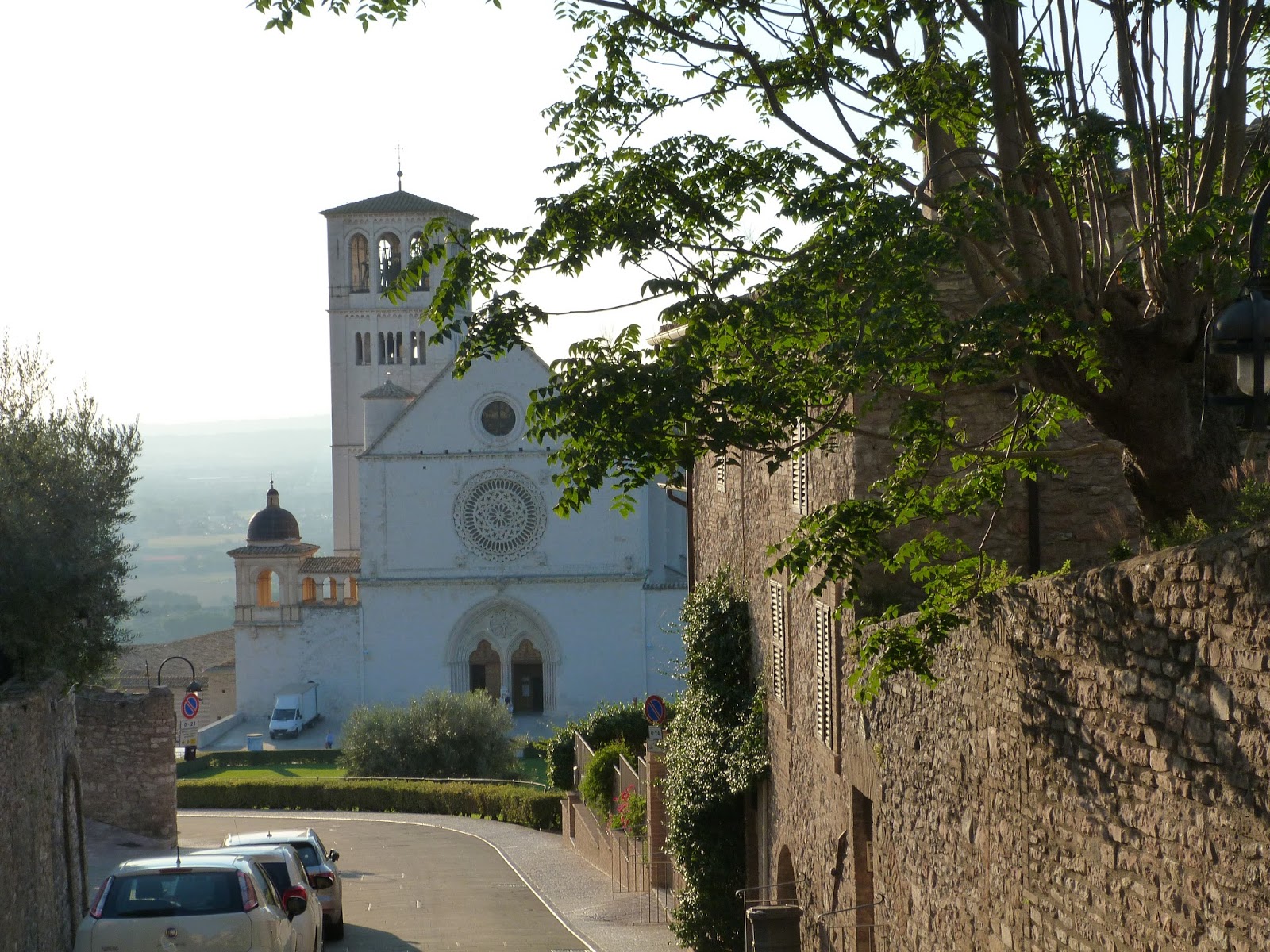
Approaching Assisi, the most visible object is the massive Church of San Francesco.

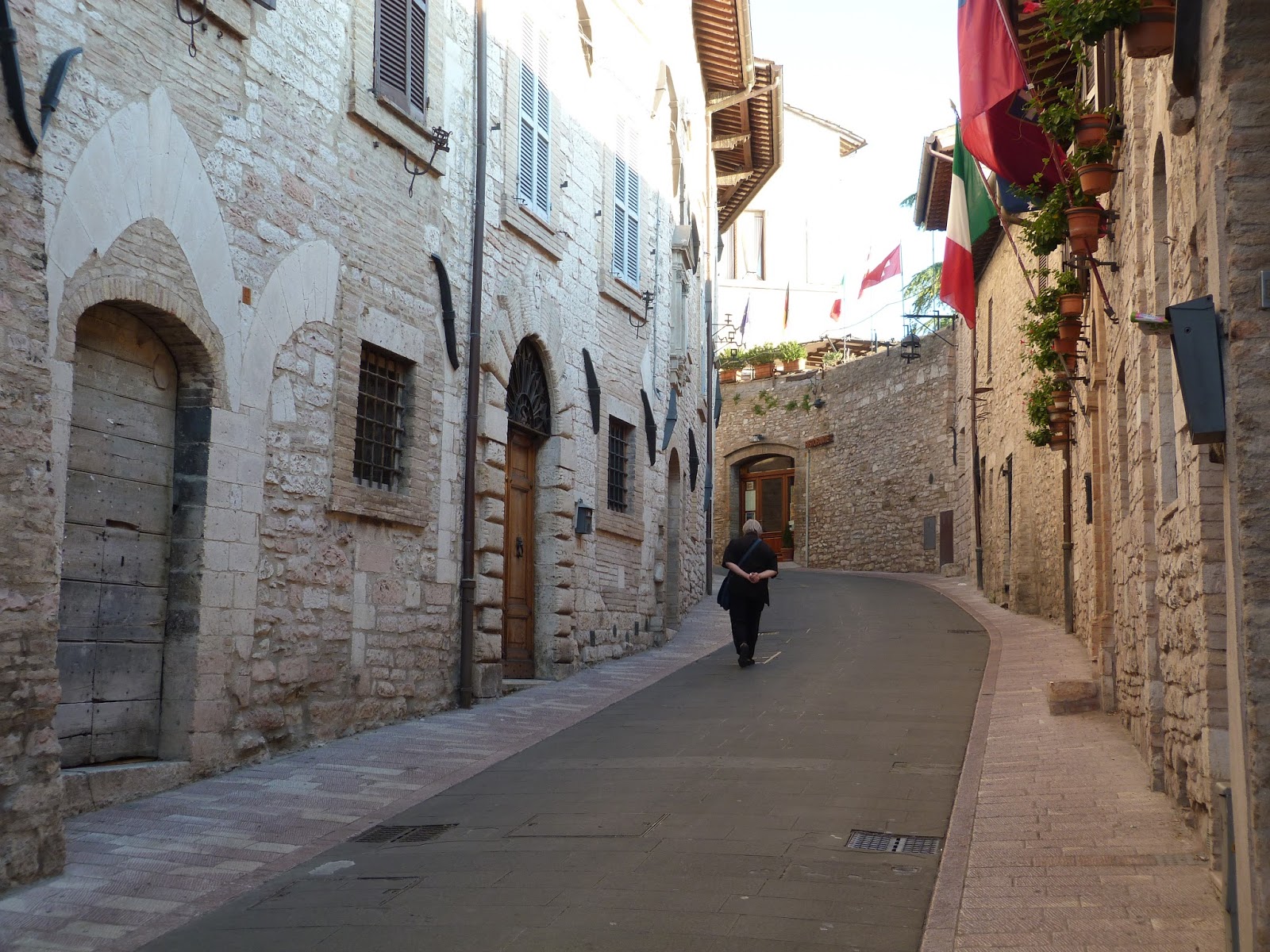
The town strikes me as odd.  It is one of those 99% sand blasted old towns that is now shockingly white - oddly, with the sole exception of two buildings still dark and dirty looking from centuries of coal burning.  It does have nice streets paved in sand coloured stone, and almost no vehicle traffic.  It is a v. quiet and contemplative place, which I suppose it ought to be.  Although the town seemed nearly empty of visitors, one could seem most were in at masses and prayers at various churches.
I went to all of them just to look.

I went to the lower area of the large one shown above to the Tomb of the Saint.  I don't know if you are familiar with the sort of contest in the Church which lasted decades, over whether it ought to predominantly follow the teachings and spirit of St. Francis, or Dominic.  Frank was known for his love of animals and being gentle in all matters.  The Dominicans were known for theological severity and harshness in punishing wayward followers.  Of course, at the top of both saints worry list were heretics, sodomites and Jews.  Let us not apply today's ethics to the distant past.  But in the end, the church went with the Dominican views, although both orders still function today.

I had a truly perfect hotel at Assii with a view over the entire countryside for a modest price.  It was a thoroughly modern styled hotel in every way, and truly hospitable at a modest price.  I wanted an extra night there, but they were fully booked.


Friar Tuck lives:  Above is a humourous photo of an Assisi friar - pretty ample with some sort of soda he is drinking from a straw on a late Assisi afternoon.  He had been doing something with a school class and the teacher wanted him to be photographed with the young people.  This is immediately following the photos when they all relaxed and were being kids again.


Spoleto

If you are  hazy on the  meaning of "hill towns," they are wonderful features of Umbria and Tuscany.  They are medieval and renaissance towns built right on the tip of high hills.  Their steep walls were no longer of wood construction, but instead stone or masonry - all for the defense of the city against hostile armies.  Most had some form of watchtowers.

 Spoleto is the most beautiful town I have ever seen.  It is parked high up on a hill top that is reached from the train station by a bus that travels in a constant spiral.  But along the way, is the long distance bus station and from there you enter the town by a series of lengthy escalators which are all in doors.
They were constructed in an effort to reduce car traffic and it has worked.  My hotel was two escalators down from the top and it was a great way to travel.


It is a town with a casual feeling, but the fine buildings around the massive plaza are quite formal.
There is an art museum named "The national gallery of Umbria."  Figure that out.  It has a lot of beautiful paintings which all happen to be religious.  There is a special reason for this I must mention .

The Spoleto festival of the two worlds  

In 1958 Gian Carlo Menotti, the famous composer and conductor instituted a festival lasting 17 days mainly in July each year, of music, dance, theatre and art.  Spoleto had been just another sleepy hill town until then.  Now it is one of the most famous of more than 50 hill towns of Umbria.


The town is also famous for the only Alexander Calder sculpture in Italy.  The title of it is Teodelapio (name of a Lombard king).  It is BIG and BLACK and dwarfs and nearly hides the train station.  It was donated to the city in 1962. The pointy arrowhead shape refers to the king's crown.


Friday, October 7, 2016

Via Veneto in Rome, 2016


My first trip to Rome was in 1965.  I was in the USAF and owned an old VW beetle which I drove all over Europe.  Once the Beetle and I arrived in Rome, I was to meet a woman somewhat older than me who was a distant relative of mine.  She worked at the U.S. embassy on Via Veneto.  At that time, VV was the second only to the Vatican in places of interest in Rome.

All of the most famous stars hung out there, and most of them stayed at the Majestic hotel.  From JFK to Fellini, to Burton and Taylor to dictators and criminals, the Majestic was THE place to have been.

Now, 50 years later, Kevin Kelleher arrives for his few nights at the Grande dame.  I had been searching furiously for weeks on hotel site trying to find a room in a convenient area with some comfort for $300. (Cdn.) or less without much luck.  Then on Venere, which mostly had junk at the time (altho I used it quite a lot in other Italian cities with great success), Hotel Majestic poppede up at 200 E instead of their usual 600-800 Euros.  I knew they must have had their worst room available at that rate, but I seized it.


The old dame has aged and been largely forgotten in Rome, but Via Veneto is a lovely street and I was glad to be back there.  The room was small, but really quiet, had a good bed, room safe and huge, all white marble bathroom.

When I was younger, I had not the patience for art and I breezed through the Sistine chapel.  Later I regretted that as I read more and more about the paintings on the ceiling there.


A friend kindly mentioned that I would have to buy a timed ticket on the Vatican Museums site.  Luckily I did that. When I first went to St. Peter's and the Sistine, 50 years ago, I don't think there were a dozen people in the Church and not more than two dozen in the Chapel.  There was no guard or security at all at the Church and  just one guard at the door of the Chapel

In the interim, while I was obv, not paying attention, the Vatican  created a new entrance in the pretty Prati area, of glass and metal now nicely hidden from the traditional views of the Vatican.  This entrance and charge (20 E.) encompasses all of the museums of the Vatican. It was lucky that my younger friend warned me about the internet ticket as the line up was blocks long.  But with that ticket, I went directly in and through security avoiding any line-up at all..

Once inside, the nightmare begins.  The immense crowds are funneled through many hallways and rooms in a genuine river of bodies jammed shoulder to shoulder, being constantly jostled for the next hour - with not one exit available to get out of there, not place to rest from the grind.  In the chapel itself, I went from side to side to grasp a rope or iron cable to look up at the works.  I did see many I greatly enjoyed and was surprised at the variety, perspectives, and perfection of the works and how they somehow were so harmonious as a whole.

Still, I could only really concentrate on finding a way out of this nightmare of tourism.  The exit ended right at the doors of St. Peter's but I wanted nothing more of the crowds, only to get away.  That was not easy.  On special occasions and important holidays, we often see thousands of chairs set up on the Bernini plaza, surrounded by temporary wood fences.  It looks to me as though that mess is no longer temporary, but instead permanent. 

Luckily once around it, and starving for some sort of food, I found a seller of Ice cream.  I ordered lemon flavour, but what he gave me was actually Lemon sherbert.  It was something I sought for the past several years and I was so surprised to find it.  It has a sharpness and full lemon flavour that I had found impossible to find anywhere else for years.

I then went on to Trastevere district.  It is like another world from Rome, although right along the Tiber, south of Vatican city.  It was at one time a Jewish neighbourhood, although it is hard to see anything particularly Jewish there.  I was only there a few hours, so may have missed some aspects.  It is so serene compared with heavily touristed areas of the city.  I wanted to stay in that area, but there are few hotels and poor transport, which may be the reason it is so nice

Photos above: The large, stubby tower is Castel san'angelo on the Tiber.   It has special meaning to me and others because in Puccini's opera, Tosca, the climax of the opera is when she leaps to hear death from that tower into the Tiber river.  However, the Rome visitor notices immediately that her leap must have covered about 200' horizontally as that is the distance to the River.

I happened to pass the Quirinale - the residence of Italy's president - during the changing of the guard with St. Peter's in the background on a fine October late afternoon.


September in South Italy: observations

If you travel on cruises or with tour groups, most complications and frustrations will be cleared away without your ever knowing of them.  If you are an independent traveller, I would say go somewhere else; anywhere else.  Austria, Romania, France,  Germany, Turkey (not sure now), Greece all are better destinations in value for money, fewer hassles, enjoyment of your vacation time and quality of food.

I wish to be clear that there was not one city, region, or time that I felt threatened in any way. Safety was not an issue for me. I understand that dealing with tourists day after day for years must be difficult.  But for the tourist, he must ask whether the ferry will stop there and whether he needs to have an assigned seat on the train (or end up standing because he did not ask), etc etc. - all without being shouted at as intemperately as possible.

To some extent, the Italians themselves are less to blame for the displeasures of visiting cities like Rome than modern circumstances.  If you have not recently been to Paris. Mont st. Michel or Rome, you will not be able to appreciate how badly these major destinations have been overwhelmed by tourists.  At the Vatican (esp. The Museums), the Louvre, and so many other important sites, the crowds are so tightly packed that you cannot see anything.  This is also true of the city itself - Paris is now basically 50 baseball stadiums with full houses exiting all at once, so the sidewalks everywhere are a sea of humans holding up little things for a photo or acting selfie-deranged.

It is an essential aspect to a memorable holiday that all or at least some food should be pleasant.  On this trip, I thought the food was usually badly prepared, low quality (meat that was almost half fat and grizzle and not much of it for $20), often seriously under cooked, and I have no doubt that many sauces and some entire plates of food came out of cans or bottles.

Every restaurant has a cover charge of $1.50 and up.  Sometimes (rarely) that includes the basket of bread they set on your table, but more often the bread is 2 E + the cover.  But if there is a cover, then you can avoid a tip.  If. for example you order veal, that is all you will get unless you choose from a range of sides at now considerable cost..  I like Penne.  I finally found a wonderful plate of Penne Ariabata in Trastevere Rome) after several dreadful attempts.

The sauce was original and delicious and the penne was cooked al dente - the right way.  But the portion was tiny.  I would say there was .50 worth of pasta and less of sauce, and the price was 13 Euros.  There was no bread.  None of these places will give you a glass of water any more.  It has to be a bottle at 2 E.  One nice place would not even sell me a bottle smaller than for four people, which was in heavy glass meant I could not take the remainder with me, and they were refilling the bottles with tap water.

At the same nice restaurant in Rome, I saw what looked like an interesting chicken offer on the menu.  I asked the waitress what part of the chicken it was for 15 E., and she had a fit.  I persisted and pointed to my legs, and chest and arms suggesting parts that might be offered  Finally, she decided that it was wings, but resented my enquiry into what I might be buying.


The Drivers of the deluge of humanity

I have read some amusing comments on what is driving this mass tourism today.  In all of the endless print media and TV reality travel shows, have you ever seen someone like Rick Steeves (such a creepy person I admit) or Anthony Bourdain bite into one of their meals and say "Gosh, that is undercooked, mediocre, or poor value for the price."  Same with wines - they are always wonderful

Arthur Frommer's blog is less ossified positivism and he mentioned one example of tourism drivers.  He said that Cinque terre in Italy has v. limited historical and cultural significance, but since one TV personality (initials seem to be RS) made it an important place to visit, it has been so badly overwhelmed that it is now about to sell timed tickets to visit in order to reduce the annual flow of visitors by "one or two million."  But I must add that cruise ships also contributed massively to the crowds.

Since to onset of the set-in-concrete paradigm of positive, positive, positive, happy, fun, no negativity please more than a decade ago, little or nothing is real.  The New York times flatly prohibited its travel writers about 10 years ago from ever writing anything negative about any country or travel.  As a result, travel writing assigns no Bs, Cs, D, or Fs, only As.  Trip advisor has come along to put some modest - if occasionally fraud or foolish - perspective on some areas of travel.

Whatever you do, avoid taxi cabs

I had a poor impressions of Italians from the 60s and 70s.  It is somewhat amusing to think that in the 60s, I was travelling on pennies, considerably more in the 70s, and a lot more in '16. The hassles in number and intensity were not lessened by spending 100 times more than on my 1965 trip.  The worst of the lot are the taxis.  At Syracuse, the bus and train station is only, truly, a five minute or less drive to the hotel, and the fare is 10 E.  I asked the hotel desk if this was correct and they said they could not believe it themselves, but could not do anything it.

Worse was to come at Assisi.  The taxis there charged 18 E. for a five minute drive.  I really objected to that one, and the driver came down to 15 E., but that was still robbery.

Ultimately, for a serene holiday with decent value for money and food. choose another country.


Wednesday, December 16, 2015

A new look at Washington, D.C. starting with Stalin's garage sale


I had not been in DC since 1974.  Previous to that, I had visited several times.  It was a violent and fearful city then.  Even - and especially - right in front of the White house, every vehicle was warned to drive 24 hours a day with doors locked and windows rolled up.  The violence was crazy.  It was supplemented by the sometimes madness of the anti-war and civil rights movements.   I once hitch hiked at night from Georgetown to Dupont circle (I must have been out of my mind).  A true madman right out of some B movie gave me a ride.  He stuttered so badly I could not understand much of what he said.  He had trouble shifting the gears as apparently whatever drugs he used interfered with supple gear shifting.

He told me he was the most antiwar of all antiwar people and had the elements of a bomb with him.  He thought I did not believe him, so when he dropped me, he got out, opened the trunk and showed me four sticks of dynamite in a grocery bag and next to them, a box opened to show some wires and electrical parts.

Another trip, I was working on my M.A. and had sold a piece of personal art to some people in Winnipeg.  They owed me $600. and said I should pick it up on the way to the airport.  That was a nice sum of money to a grad student in 1973,but now I was stuck carrying around the cash for two weeks in DC and later New York.

Once in DC, I checked in to what would be called a two star hotel right across from the new and widely celebrated Watergate hotel and complex. When I checked in, I had to ask for a safe deposit box.  The old and haggard witch at the desk was the essential definition of a hag. She saw me put the fat envelope in the box.  The evening before I was to check out she said;

Ya better take that money out of your box tonight because I have to be at the dentist in the morning and I am not sure what time I will be back.

That's o.k. because my New York train is in late afternoon.

Well, it could happen that I won't even come back and then as I am the only one with the keys, you won't get your things.

What could I do?  I took out the envelope and went to my room which was the nearest the desk - maybe only 20' from it.  Less than two hours later, there was a tremendous kicking at my door.  Two critters were intent on kicking it in.  I had just retired and was either naked or in underwear.  I jumped up and held the door, but I could hear one thug speaking to another and felt I could not hold them off.

I managed to pull two pieces of furniture over and block the door some, but they were determined.  I knew that at that time even many senators, congressmen and news reporters carried guns, so I shouted "Stop or I will shoot.  I have a gun and I will shoot."  Incredibly they stopped.

I knew the Hag controlled the phones, the - useless - air conditioner blocked the window, and I was trapped there all night.  But I was safe.  Several people in DC were genuinely horrified what would have happened to me if they entered the room as all indications were that it would have been uncivil to say the least.

Stalin's garage sale 

Over the past couple of years, I did quite a lot of study after I heard that Stalin had sold off many treasures from great Russian museums - including the Hermitage - and looted treasures from many of the great Russian estates.

It took several books to get the facts.  It seems that Lenin and Stalin, like the peasants, felt that the art sitting in museums did nothing for the hungry population which was also pumped up on building a great new society.  They set out a plan to sell off as much as possible and purchase the tractors the peasants wanted. Curiously, the accountant assigned to establish prices, set them way over market values of the time.  Even the wealthiest westerners would not pay such prices and little sold.

However, the U.S. ambassador at the time was of the Mellon family.  They were at the zenith of their wealth and were establishing and themselves building the new National galley in DC and buying wildly for their own collections as well. Both the ambassador and his wife were concerned that the hostility of the communists toward art and fine things was so ardent that they might allow some or all of it to be damaged or destroyed in such unpredictable times.  They began to purchase as much 14, 15 and 16th century works as they could

One other American involved was Armand Hammer.  Love him or not, I personally think was probably the greatest businessman of all time.  He managed to do a lot of deals with the communists.  On his first trip to Russia, he managed to meet Lenin. On a subsequent trip, while in London, he was in a junk shop and saw a desk sized sculpture of a monkey contemplating a human skull.  He presented it to Lenin, and it remained on his desk until he died.  From then to Gorbachev, Hammer personally knew every dictator except one.  He was famed in Russia for that and had a lot of leverage, you could say.

I had a great desire to visit the National gallery to see if I could identify some of the works the Mellons purchased from Stalin's big sale.


It happened that the airfare was modest. As it was the week of U.S. Thanksgiving, all the Big Big shots were out of town an I found a perfect room at the Grand Hyatt for $99 U.S. + tax; surely the best hotel deal I have ever been blessed with - and they gave me waay early check in and waay late check out at no extra charge, and they were really nice too.  It was five blocks from the W.H., and about the same to the National, the Cdn. embassy, and three blocks to the National Portrait, American art and folk art museum.

The 1st day was cold and windy, but sunny and clear.  One starts at the National Gallery outdoor sculpture garden.  It was so nice.  You will recognize Claes Oldenburg's eraser, probably not Miro's folding doughnut, and a grand chromed tree named Graft.  Perfect !

Inside we first attend the immense sculpture collection - rooms and rooms of the very best of sculpture anywhere. Suddenly, you begin to recall that many listings show the National as the greatest public art collection in the U.S.,and I would say that it is a fair appraisal.

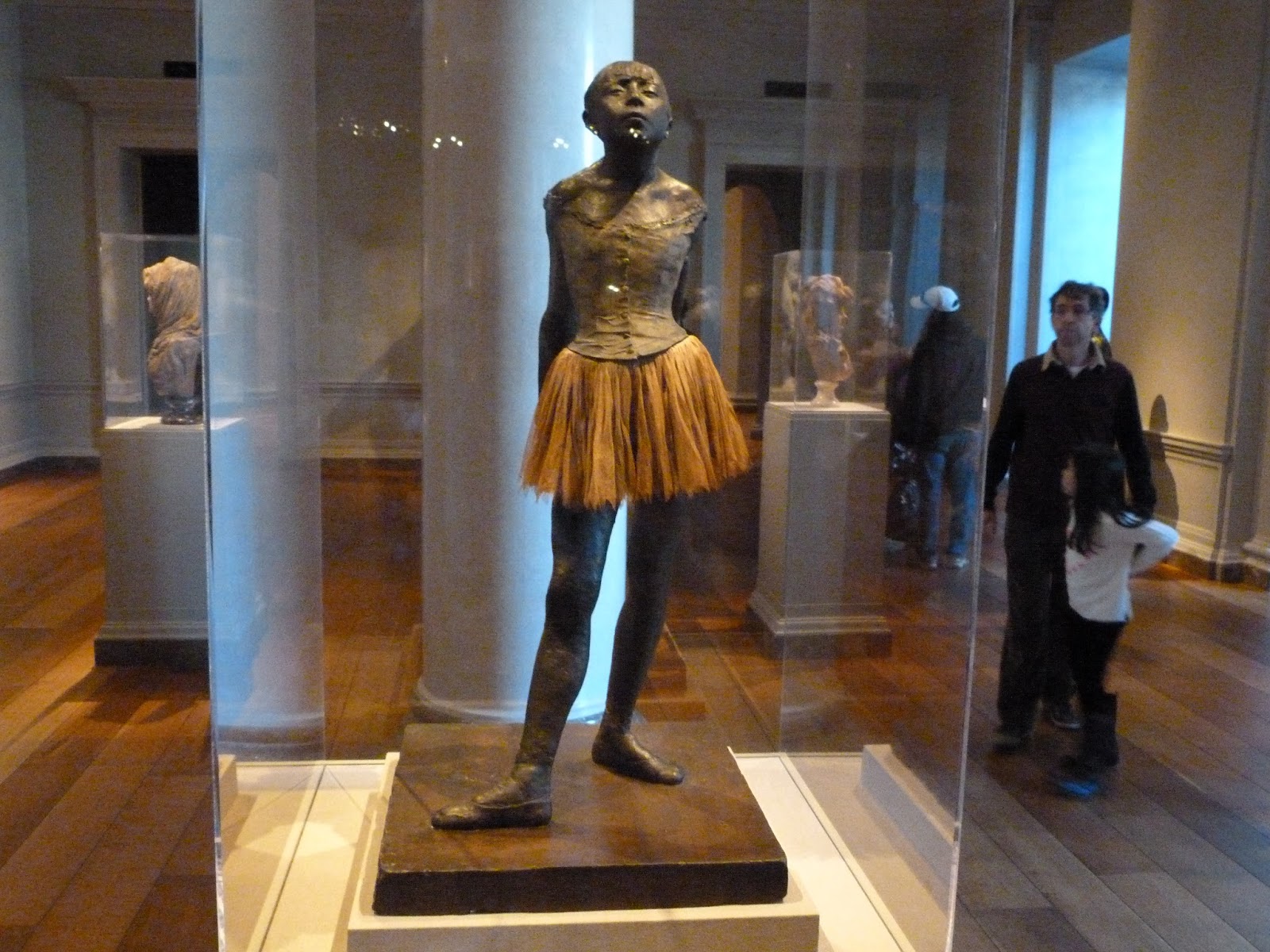
The bronze face is Mahler.  The Degas little dancer is the original one and is the very ugliest one I have seen of many. They also have the 1st one struck and it is also pretty ugly.  But the later ones I have seen prettified are not what he intended at all. The one I saw in Dresden was so beautiful (not the face, but the dress and body - but even the face was prettified cf. the original in DC) There are now so many of these (probably 300) and there have been recent indication that they are still making new ones in Paris at this moment.

The Napoleon is Jacques Louis David's.  Do you know that JLD was in Bastille for some months scheduled to be executed, but it never happened.  He was contracted by many of the inhabitants to draw portraits of them for their families.  He had little time as some were executed the day after the arrived.  But there are a lot of David portraits today that are of people he drew before they died.

There is a whole book of letters the condemned wrote to their families, which the cruel guards never delivered and remained in the archives.  I read many of them.  In the book it expands on the life behind bars in that part of the Bastille at the time.  the author said that the leading desire of condemned women was sex and as much as possible in the time they had remaining.  It happened then that the men and women were kept in the same area.  Eventually the superintendent came and told them harshly that the place had a reputation in Paris now of a brothel, and he had to then separate the men and women.


That Hopper, Cape cod evening is so compelling.  The Van Gogh self-portrait is one of  the greatest paintings I have ever seen.  You should fly there just to see it (and have lunch in the great sniffy cafe on main floor).  His forehead, and some of his hair really is green.  What can compare to that - try about 14 Rembrandts', two of which are the most famous - his self portrait and one other.  Try walking into one of many, many rooms with about 10-12 paintings and 8-10 of them are so famous they are in every book of major paintings.  It is truly thrilling to have the chance to see these works in real life and one does so admire the Mellons for the massive contributions to this grand place.  And it is free like all the museums in DC, so you can come and go frequently -as I did.


The greatest  treasure of the NG is the da Vinci - immediately above here -  (only one in U.S.) Ginevra (1474).  Mrs Mellon bought this from the King to Lichtenstein for $5 million, put it in a suitcase, bought a seat for it on a commercial flight and took it home to DC.  The Raphael Alba madonna (1510) is also a treasure among hundreds.  It is shocking for me to see the Boy in red shown above from the 15th C., in original frame and in perfect condition.  These are the kind of things that came right out the Hermitage.  I went to museum staff and asked to see the list of all items bought from Russia.

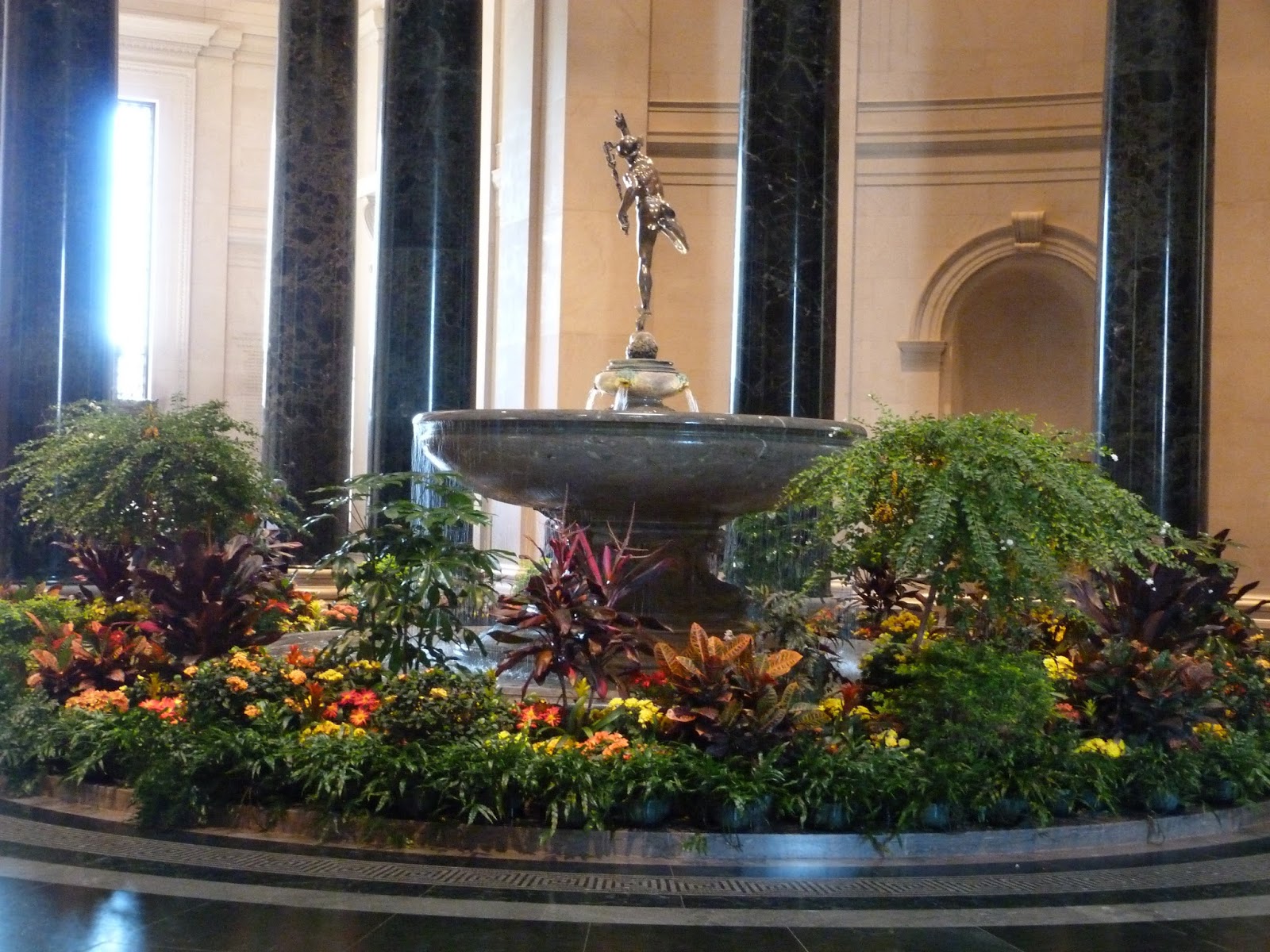
The gallery allows artists to come in and paint reproductions one day a week.  The thing that looks like a water fountain is actually a brass water fountain that is so pretty, and is one of a family of them on each floor.

I have taxed your patience enough.  I will just say that I also was pleased to visit the Hirshhorn modern museum, and the puissant Phillips collection, Arlington cemetery, Vietnam memorial, Chinatown, the Building museum and several nice neighbourhoods and fine restaurants.  What a great trip, and good for DC and the U.S. that among all the sturm und drang, dismal obsessions, fear of everything/anything, and billions of tons of truly bad art today, there is a fine city, with nice people, and so much great art.

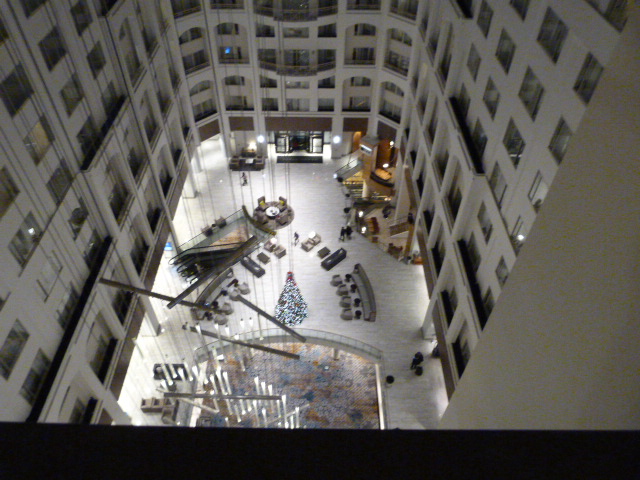
Hyatt atrium view from my 11th floor perch - altho my corner room was an external one, with a nice view.  This actually was a v. sleek hotel and my room was normally $400.